Showing posts with label Elections. Show all posts

Tuesday, October 29, 2013

Tunisia’s Politicians Play On

The Tunisian political game continues, thankfully without a brazen coup (for now), yet sadly without much regard for the needs of common citizens. Here is an excerpt from my latest analysis in the Cairo Review:

...despite deep ideological rifts, continuing economic woes, and regional pressures, Tunisia’s political game continues.
To understand Tunisia’s current political state, it is helpful to distinguish the public’s latent disenchantment, frustration and anger from the specific triggers that, in the last several months, sparked a series of demonstrations, moved large institutional players clearly into the opposition camp, and motivated opposition politicians to push for an end to Ennahda’s rule and the dissolution of Tunisia’s only elected body, the National Constituent Assembly.

To read the full article, click here.

Saturday, August 17, 2013

Tunisia and 'the Egyptian Model'

Here is an excerpt from my recent analysis in the Cairo Review:

In both Tunisia and Egypt, the state’s most important and entrenched institution remains the security establishment. In the case of Egypt, this means the army. It wields enormous political power, has close relations with the U.S., oversees the complicated relations with Israel, and maintains interests in virtually all sectors of the economy. Presidents Gamal Abdel Nasser, Anwar Sadat and Hosni Mubarak were all military men, and it seems that General Abdul-Fattah El-Sisi seeks to follow in their footsteps.
In Tunisia it is the Interior Ministry that retains potentially decisive power. This is the case particularly with the police, which was led at one point by Zine El-Abidine Ben Ali, before his ascendance to the presidency. Tunisia, under his rule, was rightly characterized as a police state. What we know of the Interior Ministry is more limited than what we know of the Egyptian army, and Human Rights Watch has described it as “a black box,” However, tiny slivers of light have begun to emerge, and the role of the ministry and the police in the current standoff between pro- and anti-government protesters may be key to understanding why Tunisia has not followed Egypt’s lead.

To continue reading, click here.

Saturday, August 3, 2013

Tunisia and the 'Arab Spring' Reversal

The following is an excerpt from my recent analysis of Tunisia's current turmoil following another political assassination. Read the full article here at Jadaliyya.

Two years ago, hope was not only palpable in the streets of Tunis; it was infectious. Young Arabs had risen up and triumphed against a Western-supported dictator whose police state ran on fear. Similar uprisings across the region seemed to have confirmed that Tunisia had led the way towards a new, more democratic order. And Tunisia was about to lead the way again by holding a clean election, almost unprecedented in the Middle East and North Africa.

Now, hope is in rare supply across the region. Egypt’s elections yielded new leaders that blindly and illiberally ran the country along strict partisan lines until a military coup publicly reasserted old-regime institutions. Libya’s timid leaders and bold militias have hampered democracy, security and institution building. Syria’s revolution turned into a bloody war and a hellish game for external actors, while Lebanon desperately tries to quarantine itself from the neighboring chaos. Western observers use increasingly desperate euphemisms for Iraq’s escalating civil war. No one dares talk about Bahrain, or perhaps no one cares. Other Gulf countries quietly quarrel amongst themselves through political and economic maneuvering in neighboring proxy countries.

While numerous pundits bemoan “Arab Spring” fatigue, many still believed that tiny Tunisia alone might overcome its challenges to create a new inclusive, civic, stable, free, and prosperous political order. But what started in Tunisia may soon end in Tunisia as the gains of the “Arab Spring” are systematically rolled back with the help of old regime forces, ascendant ideological zealots, domestic lassitude, and powerful outside players that are uncomfortable with independent, populist politics in the region.

Read the rest here.

Thursday, July 26, 2012

Lions of Libya


One family’s story from the city that broke Gadhafi’s back

Misrata, Libya

Stone and concrete lie folded like paper in downtown Misrata. Bullets and mortars and rockets have left abstract patterns of craters and soot. Sheets of metal bend like crumpled flower petals. This is where nearly 30,000 Gadhafi loyalists, many of them highly trained and extremely well armed, came to crush what had begun as a peaceful revolution.

“The stench of bodies was unbearable,” Abdulhadi al Gaid, a Misratan now living in Tripoli, says. “I didn’t think that it could ever look like a normal city again.”
 
For many months after the revolution, Misratans would not let other Libyans into their town unless they could prove their family ties to the city, partly out of security, partly out of pride. At a checkpoint near the city, at the town of Dafniya, al Gaid chats with a guard. A quick listing of family names brings smiles of recognition to both their faces and access to the town.

This stretch of highway was one of the most important fronts in the war - and one of the bloodiest. After successfully liberating Misrata, locals pushed west to link the liberated eastern part of the country with the still occupied western region, where the capital Tripoli lies. This is the road where foreign guns and artillery eventually replaced home-made weapons-systems to turn the tide of battle in favor of the revolutionaries. This is the road from where images of fighting were broadcast across the world. This is the road where one of Abdulhadi’s cousins was killed.

Rows of Gadhafi's destroyed tanks line the side of the Misrata-Tripoli highway.


But before all that, it took ordinary citizens with no fighting experience to liberate their coastal city.

“I had never seen a gun in my life except in the holsters of policemen,” says Mohammed ben Taher, 23, who fought to liberate the city and has the scars to prove it.

Sitting on the carpeted floor of his family’s living room, with the AC and lights phasing in and out along with the city’s electrical grid, Mohammad shows his wounds. He has a splotchy, pale scar under his left arm about the size of a soda can - his first injury that required hospitalization. He was transported to Izmir, Turkey to receive treatment before managing to hitch a ride back to Misrata on a fishing boat to resume fighting.

Mohammed has dozens of scars, a giant dimple in his right tricep where muscle once existed, and two straight streaks, as wide as a ruler, across his chest. His chest wound was inflicted when a 23-and-half millimeter anti-air craft bullet landed near him and two of his fellow fighters. The bullet’s impact sent shrapnel into Mohammed, some of which remains in his neck, jaw, and cheek. The medical reports from his hospital stay in Tunisia tell him that his heart stopped twice, that he required artificial breathing, and that he had serious internal bleeding near his heart and lungs – little of which he remembers after waking up from a twelve-day coma.

He still has shrapnel in his back from another battle, which makes it difficult for him to sleep lying down. When he does manage to fall asleep these days, it is usually in a chair.

But Mohammed was the lucky one.

The Libyan Insurance Building, looms above downtown Misrata. Its white walls are now broken and blackened from gunfire. However, for weeks on end in the spring of 2011, Gadhafi’s snipers destroyed the building’s stairs to cut off access, and used the roof to pick off countless revolutionaries. In an alleyway not far from the building, Hisham ben Taher, Mohammed’s older brother, was shot and killed on March 6.
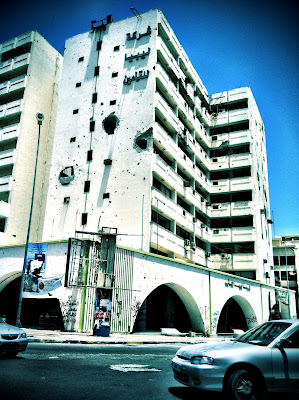
A photo of the Libyan National Insurance Building in downtown Misrata


Mohammed and the younger of his two older sisters, Halima, show me a video on their iPad of Hisham’s last moments. The footage shows Hisham sprawled in the middle of the street as two young men attend to another wounded man lying several feet from Hisham. The men wait for the gunfire to stop so they can retrieve the older ben Taher. Within two weeks, both men would be dead.

Halima and her older sister, Ilham, who sits in another corner of the room, shed silent tears before continuing their story.

“It’s strange,” says Halima, as Mohammed retreats back into silence, his head twitching, his tongue flicking inside his cheek, his shoulders jerking up from time to time. “We lived in a war, but we did not live in fear. We used to see the Palestinians before the war living, eating, drinking, marrying – we used to ask ‘how can they live?’ Then it happened to us.”

Ilham nods in agreement. Why weren’t they afraid?

“We knew that when they are here, the boys won’t let us get hurt,” says Halima.

As Ramadan ben Taher, the father of the family, quietly brings coffee and fruit to offer his guests, the youngest son, Abdurrahman, sits sheepishly near Ilham. His sisters did not allow Abdurrahman, now aged 17 but only 16 during the war, to fight alongside his brothers. One day he ventured outside the confines of the family’s besieged basement to join his brothers only to have his foot shattered by a stray bullet. Trapped by gunfire, he lay on his own street for hours, losing consciousness twice before neighbors rescued him.

On the iPad, Halima and Mohammed show photos of their house’s gray, destroyed façade, unrecognizable from the now rebuilt house surrounded by greenery. On March 13, five days after Gadhafi forces stormed the city, the girls, Abdurrahman and their mother fled to a relative’s house, using small openings in backyard walls to navigate across the neighborhood’s alleys.

The family spent five days in Halima’s uncle’s basement, along with 103 other people.

Asked about the conditions there, Halima chuckled. “The kids wanted warm bread. We only had old bread.”

Navigating back to normality

Now that the war is over, Halima has returned to teaching primary school. Ilham has returned to teaching the Quran at the local mosque. Abdurrahman has begun his first year of university in the faculty of engineering, and their father, a retired businessman, beams with pride.

Everyone seems to have returned to normal except for Mohammed. He says he doesn’t believe in school, and will not return. Asked if he is working, he replies no, prompting a patient, almost gentle silence as the family smiles lovingly in his direction. Ramadan quietly mentions that he would like to see his son go back to school, but looks pleased when Mohammed says he would like to start his own business someday.

The family has just voted in Libya’s first multi-party election since 1952, proudly brandishing their henna-stained fingers. They say they have all voted for Mahmoud Jibril’s National Forces Alliance, a non-Islamist coalition that has shirked ideological debate and focused instead on the practical steps needed to rebuild the country.

“What Mahmoud Jibril says is what we dream,” says Halima.

However, Mohammed’s scarred hands remain unstained.

“I don’t want to give my vote to anyone. There are still too many problems,” he says. “When Gadhafi was alive, we were still one people. Now people have changed.”

Mohammed says he has unsuccessfully applied to the local medical board four times for a grant to be treated outside of Libya. Apart from medical treatment for himself, he says he wants the country to have a better education system, solid infrastructure, rule of law and the removal of guns from the streets.

“Of course I have hope, but things will be slow,” he says, conceding that he would prefer to move to the United States.

Asked why he went out to fight in the first place, he responds immediately with only one word.

“Freedom.”

This photo, taken days after Libya's July, 7, 2012 elections, shows a wall in downtown Misrata covered in revolutionary graffiti.

Monday, July 23, 2012

Libya's New Politicians Resist Labels


Libyans celebrate election day on Omar Mukthar Avenue in downtown Tripoli, Libya on July, 7, 2012.


Tripoli, Libya

Sitting in his garden in the Tripoli suburb of Ain Zara five days after the July, 7 elections, surrounded by a circle of friends and family chatting quietly, Abdelnasser Siklani watched his TV screen as Libya’s Higher National Election Commission announced results. Siklani, an independent candidate for the new General National Congress, had just heard the news that he had won a seat, but was waiting to hear it confirmed on televised broadcast.

Suddenly the results for the district, which has two seats in the new congress, appeared on screen. Siklani rushed up to the screen and held his finger over his name. He had indeed come in second place, ahead of the next candidate by less than a hundred votes.

For Siklani, a businessman, this foray into politics is totally new.

“This is a special feeling you can’t get in business. This dream was always inside me, but now I can transfer my feelings and love of Libya through a program,” he says.

In the new Congress, only 80 out of 200 seats were reserved for political parties, with the rest left to individual candidates. This has made determining the political leaning of the new body difficult to identify, particularly in a country where there were no politics for 42 years under the rule of former dictator Moammer Gadhafi. While the non-Islamist National Forces Alliance, or NFA, of former interim Prime Minister Mahmoud Jibril, has performed exceedingly well in these elections, other parties have said that they intend to tip the balance by attracting independent congressmen to their cause.

According to Siklani, he has already been contacted by five, different political parties seeking his support, with one phone call coming only minutes after his victory.

“All parties are calling me to get me to join, but I will remain independent,” he says.

Siklani says he is skeptical of parties that were formed too quickly.

“I don’t rely on theories or ideas. When I see something in practice that works, I will go to that,” he says.

Siklani says his skepticism of the political parties comes from the lessons he learned when he spent 7 years in Gadhafi’s Abu Slim prison. Siklani was jailed twice for plotting to assassinate Moammer Gadhafi. The first time came, in 1980, when he was a pilot stationed at an airbase in Sirte. Noticing that Gadhafi only traveled with a dozen-car escort in this Gadhafi-friendly town, rather than the normal 100 in Tripoli, he hatched a plan with one co-conspirator. Siklani’s confidante let the plan slip to a third party. Siklani was arrested, but managed to convince the jailers that his partner was simply trying to climb up the ladder of success by inventing traitors.

The second time Siklani plotted to kill Gadhafi was in 1982 in Benghazi, and this time he was caught.

Siklani’s brother, Abdelrazek, celebrating tonight in Ain Zara, recounts looking for his jailed brother for three years.

I lied about my age so I could get a license and drove house to house around Tripoli to try to get information and clearance [to see Abdelnasser],” he says, noting that the family had no idea whether he was alive or not.

Abdelrazek and his mother were finally granted permission to see Abdelnasser in prison in 1985.

“I think the guys sitting around him tortured him. He couldn’t even walk, his legs were blue,” Abdelrazek says.

“Your mom had to watch it,” Abdelnasser interrupts, pointing out that he had to pretend he was in better condition than he actually was so as not to worry his mother.

The Siklani story, like thousands of others in this city, gives a clue as to how external political influences, like Islamism, have failed to mold the political landscape of this fiercely independent country.

“We learned enough from Gadhafi that no one will cheat us in the future, even the Libyan parties,” he says.

This attitude may help to explain how the NFA, which has thus far shirked ideological labels, managed to secure a sweeping victory. Following the elections, NFA head Jibril gave a press conference specifically to reject the labels ascribed to his coalition by the media.

“Some media channels, Arab and non-Arab, started referring to the National Forces Alliance as liberal and secular. That’s not true. This alliance is open and it is composed of all political mixtures of Libyans,” he said. “This alliance is an alliance of the national forces. It has no relationship to any ideology.”

He also went on to reject the labels of ‘leftist,’ and ‘Islamist.’

According to the NFA’s General Secretary, Doctor Faisal Krekshi, the NFA learned well the lessons of Tunisia and Egypt. He noted that in Tunisia’s first democratic elections in October of last year, the Islamist Ennahda party won less of the vote-total than all the non-Islamist parties combined, but took power because the others remained divided. Learning from that experience, Krekshi says that Jibril toured 30 cities in November and December, talking with local political groups and non-governmental organizations to build the NFA’s current 55-party coalition.

Beyond grassroots coalition building, Krekshi says the NFA has beaten Islamists by taking debate to a higher level.

“We should provide for the basic needs of people, then we can talk about politics. We feel that it is more important to build the future principles of Libya rather than debate about secular or Muslims or stupidity like that,” he says. “We never go into a level where debate is so cheap. We prefer that debate will be about what you can offer and provide as a program, schedule, timetable and tools. But debating that you are Muslims, non-Muslims; you are secular, they are not secular; you drink, you don’t drink; you pray, you don’t pray – that’s not the way to build a country.”

More than that, Krekshi says that talking about religion as a political matter, in a country where nearly everyone is Muslim, is moot.

“This is a 100% Muslim country. You cannot speak about secularism. It’s like speaking about secularism inside the Vatican. That’s crazy,” he says.

The NFA has instead put forward basic guidelines for fixing Libya’s security challenges and preempting calls for federalism by advocating a policy of decentralization. Siklani, who says he is similarly opposed to ideological debates for now, says his first priority as a newly elected official is to solve Libya’s fragmented security apparatus.

“We cannot talk about politics while people have no electricity, have no clean water, when health services are not provided, when you have no laws, or telecommunications. Those are essential needs for your people. You should provide, and then you can talk about politics,” Krekshi says.

Monday, July 16, 2012

In Libya, Ink-stained Hands Pen a New Chapter

A mother (C), her daughter (L), and their family friend wait in line to enter the voting booths at the Ali Oureyeth High School in Tripoli, Libya on July, 7, 2012.


The following is an excerpt from my latest piece in Egypt Independent on Libya's historic elections:

Into a sun-washed courtyard, yards away from a street full of blaring car horns and waving flags, Laila Gurgi and her husband Mohammad al Taboli step out of the Ali Oureyeth High School. The couple has just voted for the first time in their lives, and they are smiling.
“It is difficult to explain how we are feeling,” she said. “It’s like a dream. Today we touched the sky.”
A stranger, Khansaa al-Obeydi, approaches to congratulate the couple on voting.
“We suffered a lot. Today we forgot everything except our martyrs,” al-Obeydi says.
Saturday marks Libya’s first multi-party election since February 1952. There are over 2000 candidates vying for 200 seats in a new temporary assembly tasked with picking a cabinet and appointing a new prime minister. There are lingering security concerns around the country, and many worry that some groups pushing for greater autonomy in the eastern region of Cyrenaica will destabilize a country recovering from a bloody revolution. However, the residents of Tripoli today downplayed these threats and took to the streets en masse, celebrating what many see as “victory day.”

Election volunteers display their henna-stained fingers after voting at the 'Turkish-Mosque' primary school and voting center in Souk Al Jouma neighborhood of Tripoli, Libya, on July, 7, 2012.

Tuesday, June 26, 2012

Libyan Elections: A historical note

Reading Libya: The Struggle for Survival, Geoff Simons' (at times very biased) historical account of Libya, I came across a passage about Libya's 1952 elections:


Political parties contended for power in the general election of February 1952, after which they were dissolved and banned. Two opposing tendencies had come into conflict: the Istiqlal [Independence] party under Salim al-Muntasser, linked to business and the British military administration; and Bashir Bey Sadawi's National Congress Party, leaning towards the Arab League. The Congress Party won all the seats in Tripoli, but lost in the rest of the country, a result that confounded its expectations and led to claims that the government had rigged the ballot. As soon as the results were announced Congress supporters invaded the government buildings, cut telephone wires, and blocked transport. The government arrested scores of demonstrators, banned the Congress Party, and banished Sadawi to Egypt. The fledgling multi-party politics of independent Libya had collapsed at the first test, and it was destined not to return: factions continued to operate on a clandestine basis but healthy political contention was at an end.

Hopefully history will not repeat itself, and the upcoming elections on July 7th will be the first step to a lively, but peaceful, representative political system.

Sunday, December 18, 2011

Faces of Tunisia’s ‘sit-in’ protesters

Protesters of numerous political stripes demonstrate outside Tunisia's new Constituent Assembly in Tunis, Tunisia on December, 6, 2011.

December, 6th marked day six of a sit-in protest in front of Tunisia’s newly elected constituent assembly in the Tunis district of Bardo. Dozens have camped out in tents, while thousands from diverse groups with diverse political objectives have come to make their voice heard as the country’s newly elected governing body begins plenary sessions. Many of the demonstrators appear to be in agreement on at least two things: they want more checks on the power of the constituent assembly, and they want the government to tackle the high rate of unemployment.

“We want to prevent the imposition of a new dictatorship - the dictatorship of the majority,” says Wassim Meddeb, a recent university graduate and filmmaker.

Meddeb came to Tunis from the coastal town of Klibia and has been living in a tent adorned with political placards with fellow demonstrators for almost a week.

“We need a civil, liberal state, one that addresses unemployment,” says Meddeb, who has himself been looking for jobs for over a year.

The Islamist Ennahda party won roughly 40 percent of the votes in Tunisia’s historic October 23 election. They have since worked to create a coalition with the leftist parties CPR, which came in second in the elections, and Ettakatol, which came in fourth. Ennahda Secretary General Hamadi Jebali took the post of Prime Minister, CPR leader Moncef Marzouki is set to become President, and Ettakatol leader Mustafa Ben Jaafar is President of the Assembly. However, many are worried that the President’s role in decision-making may be limited, providing little check on Ennahda’s ability to govern without consensus.

“The other party leaders will become figureheads without real power,” says Sonia Dridi, an English student at Tunis’s High Institute of Human Sciences. “[The constituent assembly] has to divide power between the Prime Minister and the President.”

Other protesters held placards calling for a proper separation of powers between the executive and legislative branches of power. Many say they want all legislation in the assembly to be passed with a two-thirds rather than a simple majority. Tlijani Hassane, a youth union leader who rooms with Meddeb in his makeshift shelter, believes that government ministers should not come from the ranks of the elected constituent assembly.

“We want a parliamentary system with precautions. If they combine powers, there will be one power that will dominate the system,” he says.

Others are calling for greater accountability and transparency by asking the government to televise all the assembly’s proceedings on a separate, national television station.

“We want parliamentary TV. We want to see with our own eyes,” says Dridi. “We don’t have confidence in our journalists. They are biased, with no critical views.”

The constituent assembly is tasked primarily with writing a new constitution and laying the groundwork for the next elections. At the same time, the assembly is also tasked with the role of creating an interim governing mechanism. Prior to elections, many civil society groups in Tunisia advocated for holding a referendum, parallel to elections, that would limit the assembly’s power and duration. The referendum was never held, but a group of 11 parties agreed amongst themselves to limit the duration of the assembly to one year before holding the next elections.

However many are concerned that the apparent lack of systemic checks on the assembly will lead to a concentration of power.

“There is no democratic system in the world that does not have a separation of powers,” says Mechergui Haifa, a medical student who is working as a volunteer at the Bardo protests.

THE UNEMPLOYMENT FACTOR


Haifa, along with several other volunteers, has been visiting the tents, providing check ups and medicine to those spending cold nights outside the assembly. Most of her patients are unemployed, and she says that fears over unemployment, which according to the latest figures stands at 18 percent, run just as high as fears over concentration of power.

“The situation is miserable. We cannot work. Even doctors cannot find work,” she says.

One person at the sit-in that Haifa checks up on is Ridha Amara. Amara, a 35-year-old from the phosphate mining town of Gafsa, has been out of work for 5 years despite holding a master’s degree. He, along with dozens of other out of work miners from Gafsa, came to Tunis to join the Bardo sit-in a week ago.

“They have disputes over the next president, but we just want a job. They leave us here,” he says.

Mouldi Shanafi, an English teacher who also says he has been out of work for five years, has come to the Bardo protests three days in a row.

“They are simple people just defending their right to work, like me for example,” he says describing many at the protests.

However, he says there is second group among the protesters with a more political agenda.

“They want to break this victory of Ennahda and to win the presidential post in the next elections. They are preparing now for the next elections,” Shanafi says, pointing at what he calls the “election losers.”

But some, like Amara, are just sick of the whole system.

“We are here for a new revolution against a new dictatorship,” Amara says.

Sunday, October 23, 2011

Tunisian Election Predictions

Tunisian polling stations are just closing now, at 7pm local time, but voting will continue until all those in voting bureaus at the time of closing have voted. The Independent High Electoral Commission, or ISIE by its French Acronym, has announced that final results will likely not be available until Tuesday evening. As we wait for results to come in, I would like to venture a couple predictions, assuming voting and counting take place fairly.

1- Islamist-oriented Ennahdha is likely to win over 40%

Ennahdha is the best organized party in Tunisia, and by far the most popular. There are several reasons for this. As one Ennahdha member told me earlier this week, before Ennahdha was a political party, before it was even a movement, it was an organization - mainly of religiously oriented, underground political activists - which has its roots in the early 1980's. It has invaluable grassroots experience, which it has used to organize rallies (and according to unverified rumors - weddings, religious ceremonies, and community giveaways) and motivate their broad-based constituency. While the latest polls, which came out prior to the campaign season, put Ennahdha support at about 20-30%, undecided voters, which made up over 50%, are likely to swing in favor of Ennahdha.

Dozens of taxi drivers have told me, "the others are all thieves" in their eyes - Of course this must be taken with a grain of salt, but perception is important and the anecdote seems to hold water. Prior to the campaign season, the two parties at the top of the polls, Ennadha and the Progressive Democratic Party (PDP), were also the two with the biggest name recognition. While both Ennahdha leaders and PDP leaders spent time in jail under Ben Ali's regime, more Ennahdha leaders spent considerably more time in prison than PDP leaders. On top of that, PDP was a legal party under Ben Ali, trying desperately to be the voice of opposition in a political entity that tightly controlled opposition. These differences have worked to convince many Tunisians that Ennahdha was truly the voice of opposition against the old regime.

2- PDM is likely to come in second

PDM, or Al-Qotb, or the Pole Democratique Moderniste, is a coalition grouping of 4 leftist parties and 5 citizen initiatives. The best known of the parties, Ettajdid, is an old party that branched out from the communists and was legal under the former regime. The grouping has worked hard to be the voice of the Tunisian left without distancing itself from Islam. They have managed to organize impressive rallies that draw enthusiastic crowds, made up primarily of young Tunisians. They have also included numerous young candidates in their candidature lists. By grouping together, the movement has managed to tailor its message, with one party targeting artists, another evolved communists, and yet another internet activists who want an internet free from corporate interests and censorship. Meanwhile, Tunisia's best known communist party, POCT, has lost considerable support from leftists after hints from its leader, Hamma Hammami, that it will work together in coalition with Ennahdha. As for more centrist parties, like PDP and CPR, it seems as if Tunisians are likely to stay away from the "safe choice/center" parties the first time they cast their ballots.

Tunisia's Identity politics

Here is a brief excerpt from my piece in Al-Masry Al-Youm this week:

Rachid Ghannouchi, the leader of the Islamic-oriented Ennahda (Renaissance) Party, drew attention this week when he suggested in several interviews that his party would win a majority in the upcoming parliament. However, at a press conference in Tunis on Wednesday, Ghannouchi warned that "there is a risk of the election results being manipulated.”

“If there is manipulation, we will rejoin the forces and the guardians of the revolution which ousted Ben Ali and the first [interim] government. We are ready to oust up to ten governments if needed,” he was quoted as saying.

The comment has drawn concern from other Tunisian political parties, including the the Progressive Democratic Party (PDP).

“We are not going to work with them, especially after this last declaration,” says Ahmed Bouazzi, a member of the PDP’s executive committee. However, PDP insists that it will respect the results of the election, regardless of the results. “We believe these elections will be fair. We will accept them because we are democrats. If Ennahda wins the majority, we will accept the result.”

Ennahda insists on shucking the “Islamist” label, instead saying that it is a party with an Arab-Islamic “reference.”

“For us, the respect of Islam, of our history, our civilization, that’s the base of our party,” says Nourreddine Arbaoui, a member of Ennahda's political bureau.


The entire piece is available at http://www.almasryalyoum.com/en/node/507192

Monday, October 17, 2011

Tunisia's bumpy path to democracy

Here is a brief excerpt of my latest piece in Foreign Policy:

TUNIS, Tunisia — On the eighth floor of a whitewashed building in downtown Tunis, Kamel Jendoubi sits bleary-eyed at a desk drowning in papers, his day full of meetings and far from over despite the darkening sky outside his window.

Jendoubi is president of Tunisia's Independent High Election Committee (ISIE by its French initials), tasked with supervising the country's first elections since the fall of President Zine el-Abidine Ben Ali. Scheduled for Oct. 23, they will also be the first popular elections in any country whose ruler was ousted by the Arab Spring. Unlike Libya, Tunisia has experienced relatively little violence, and unlike Egypt, the old regime has relatively little power to perpetuate itself.

But Jendoubi's task isn't easy. He's beset with a growing roster of concerns, ranging from reports of election corruption to limited resources and experience. "For me, we don't have enough election officials. … We are hearing rumors of parties and candidates giving money to voters," he says.


The full article is available here.